
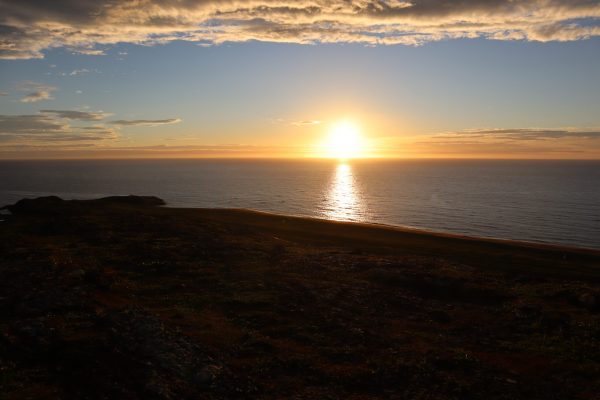
It is a phenomenon everyone should experience at least once in their lives: the Midnight Sun. The sun remains visible above the horizon for days, weeks or even months on end. It is weird to experience only having daylight. And in this article, we want to tell you a little bit more about the Midnight Sun, where you can see it, and how you can experience it.
What is the Midnight Sun?
The Midnight Sun, also known as polar day, refers to a period of daytime that lasts at least 24 hours. The phenomenon can be seen north of the Arctic Circle in Norway, Sweden, Finland, Iceland, Canada, Russia and Alaska (US). It is also possible to see the Midnight Sun south of the Antarctic Circle, though it is easier to see it for yourself in the Northern Hemisphere.
The Midnight Sun occurs because of the tilt in the Earth’s axis towards the sun. The Earth spins around once a day, which is what makes it looks like the sun rises and sets each day. The Earth orbits the sun once a year. However, the Earth’s axis is a little tilted towards the sun in summer and away from the sun in winter, which is also what causes the seasons.
Because of this, during the summer solstice, part of the northern hemisphere has continuous access to the sun, causing the Midnight Sun. This is why it is also called Polar Day. The opposite of this, Polar Night, happens during the winter solstice when the sun never rises. How long this lasts depends on the location.
Where can you see the Midnight Sun?
Because no humans live south of the Antarctic Circle, the Midnight Sun can be seen best north of the Arctic Circle in Northern Canada, Alaska (United States), Iceland, Finland, Norway, Sweden, Greenland and Russia.
It depends on how far you are in the Arctic Circle on how long the Midnight Sun lasts. In Svalbard, Norway, the sun doesn’t set from approximately the 19th of April till the 23rd of August. Whereas in Bodø, Norway, the sun doesn’t set from the 4th of June till the 8th of July.
It is a weird phenomenon in the beginning to experience. It messes with your mind as you can’t guess time anymore. You sleep less or lose your circadian rhythm.
READ MORE: The North of Norway
What can you do during the Midnight Sun?
There are so many ways and places to experience the Midnight Sun. You could fish, hike, or kayak in the middle of the night while the sun is still up. There are also special tours to see wild animals or go photograph this unique phenomenon.
Our special recommendations are to go to Tromsø, which is a lovely, vibrant city. Here there is a lot of activity around the Midnight Sun whilst you also can go to fun restaurants and cafés. Another good option is Lofoten Islands. This popular destination only has Midnight Sun for a short while, but the beauty of the islands is enhanced by the never-setting sun.
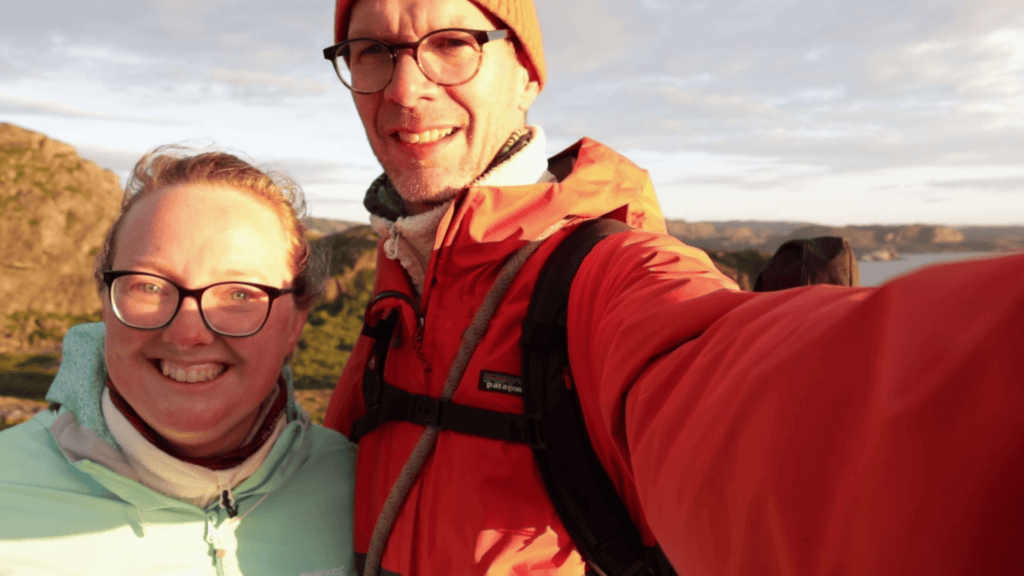
We hiked at Grense Jakobselv, the border between Norway and Russia, during the Midnight Sun. It was stunning. Don’t forget your sunscreen because even though it is the middle of the night, the sun is still up and powerful – We learned the hard way!

Our Experience with the Midnight Sun
We noticed the Midnight Sun effects before we even reached the Arctic Circle. We were at a motorhome parking near Skuleskogen National Park when we asked each other what time it was. We thought it would be around 9 or 10 pm. It turned out it was already midnight, but it wasn’t completely dark out. See, outside the Arctic Circle, the sun might still set, but the night just becomes a long twilight. This was so weird to realise.
It took us a few nights to learn how to sleep in the light, especially after we crossed the Arctic Circle at Rovaniemi and the sun really did not set anymore. We would go to bed really late and wake up early again. We’ve heard from others that some completely lose their grip on day and night, so we did our best to make sure we went to bed at reasonable hours.
Though the sun was always there, we weren’t always very aware of it. But the walk at Grense Jakobselv (as mentioned above) was a really nice moment to really realise how special this phenomenon is.
We visited the North Cape when the sun barely touched the sea before rising again. It was a stunning sight, and we were not alone in experiencing it. It happened to be the last night you could experience the Midnight Sun there; the next day, the sun would go, although shortly, just below the waterline. We didn’t know this before going to Nordkapp and were a bit confused by the amounts of people there. But it was such a fabulous experience to see the sun touch the sea and rise again. And so there were a lot of people who wanted to see this as well.
READ MORE: Midnight Sun at the North Cape


When are YOU seeing the Midnight Sun?
In conclusion, the Midnight Sun is a spectacular natural event that occurs north of the Arctic Circle during the summer solstice. It is a sight you have to see at least once in your life, just as you need to see the Northern Lights, which occur around the winter solstice. Have you seen The Midnight Sun already?
Pin this:


