
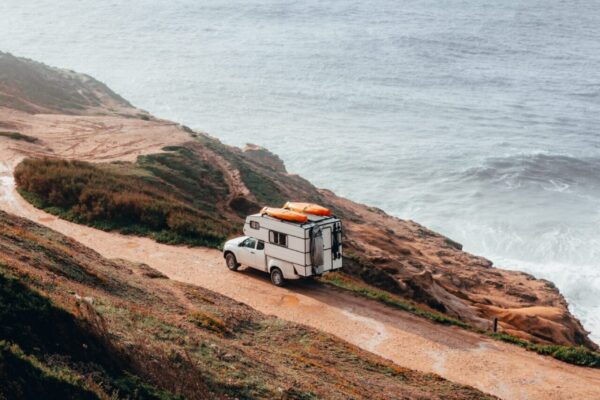
Camper, motorhome, RV, trailer. When trying to find information about your travels, you will notice that there are different terms for the vehicle you live in.
But what is the difference between a camper and an RV? Or does it mean the same thing? Is a motorhome the same as a campervan?
In the beginning, we thought that RV was the American word for motorhome, which is also called a camper in parts of Europe, but the thing turned out to be much more complicated. Most terms mean different things depending on where you are.
So in this article, we will try to explain camper, motorhome, RV, and trailer – each term and talk to you about the different ways a word is used.
RV (Recreational Vehicle)
RV is the abbreviation for Recreational Vehicle. While this term is mostly used in America and is seen as the American term for motorhomes in Europe, the term actually is an overarching term for all vehicles you can live in while travelling, no matter the size. So it’s not just for motorhomes/campers but also for caravans, trailers and anything else that you could live in and travel.
There are drivable RVs as well as towable RVs. Drivable RVs have a car component, while towable RVs must be connected to a car or truck.
Motorhome
A motorhome is a vehicle that has living quarters. Most of the time, there is a front cabin with driver’s seats, a living room area, a kitchen and bathroom, and a sleeping area.
There are different versions of motorhomes. Integrated motorhome, semi-integrated motorhome and the alcove. The alcoves are easily identifiable as they have a sleeping area above the front cabin and a window up there.
Semi-integrated motorhomes have an area above the cabin that is still part of the cabin but visible from the outside. You can see which part of the vehicle is the ‘motor’ and which is the ‘home’. Our camper (see next word) is a semi-integrated motorhome.
There are also fully integrated motorhomes. Here the ‘motor’ and ‘home’ have become one big object, and they offer a seamless transition from cab to living space. The windshield in front looks like a bus. In some cases, these also are the length and size of a bus, which means you will need a special driver’s license to drive them.
There is also the campervan which we will get back to in a bit.
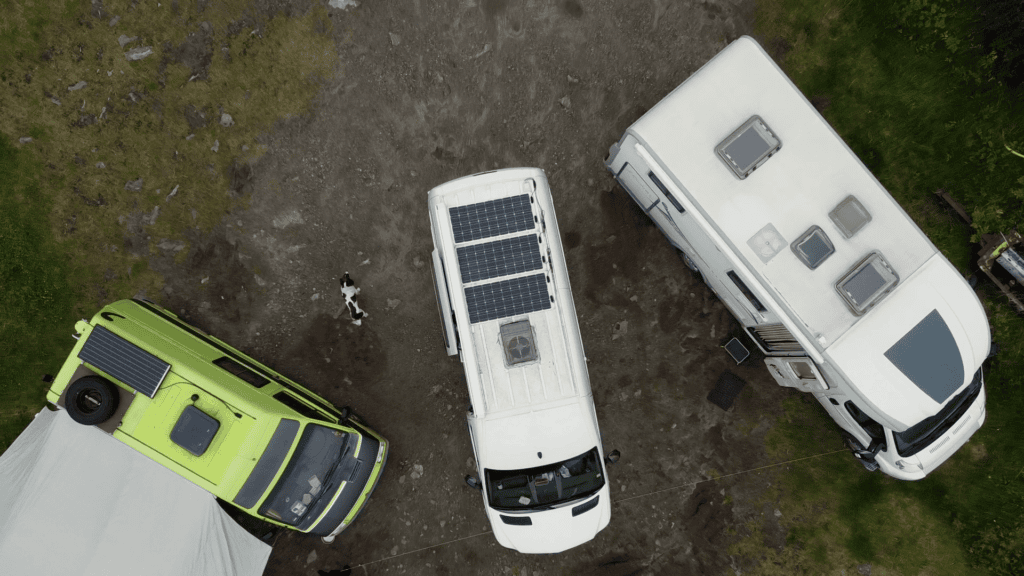
Camper
In parts of Europe, the term camper is used for motorhome. They mean the exact same thing, though. It is a bigger vehicle to travel in, with all of it being one thing (not something you tow like a caravan/trailer, see below). You might also see it as ‘camping-car’ in France.
In America, the term camper is generally meant to be a travel trailer or caravan (see below). The term camper is also used for the people who camp, making it one of the most confusing terms around.
Campervan
Campervans are used for two different forms of motorhomes that have the same size:
Vans that are converted into campers, aka motorhomes. These home-built vans are used for van life a lot, though sometimes they are used for holiday travels too.
But campervans can also be sold by companies as motorhomes in the size of a van.
These smaller motorhomes offer less space than the other three variants mentioned above but have more flexibility in where they can go, making it easier to park them somewhere.
Caravan or Trailer
A caravan is a European term for a trailer that holds a living space. A caravan is not a motorhome because it does not have the capability to travel without a separate car or truck that is pulling it. A caravan is considered a towable RV.
In America, these are called travel trailers.
READ MORE: What tires are right for your motorhome, RV or camper – Summer vs All-Season Tires
What kind of RV do you want?
Hopefully, this article helped you learn more about the differences in motorhomes. And will help you figure out what the vehicle you have is called or what you want to buy or rent.
No matter the kind of RV you (want to) get, keeping in mind the weight of your motorhome is really important. And organisation can help with that.
READ MORE: The weight of your motorhome
Camper Organisation
If you have any questions, don’t hesitate to reach out to us.
